Friday, May 14, 2010
Esperanza, Inc.

Thursday, May 13, 2010
Parflex Division
I am working at the Parflex Division of the large engineering company "Parker Hannifin." I was contacted by Jane Heim about a few months before this started. She told me that I would be working on an air tube harness #3866503 for an Oshkosh truck. That pretty much scared me from day one. I had no idea what an air tube harness was. Couldn't even guess what the numbers stood for, and I thought the "Oshkosh" was just a typo for some other word I probably wouldn't know. I didn't really bother to worry about it until I got here. Turns out an air tube harness is a bunch of long tubes attached together that are used for trucks and other vehicles. This specific harness, labeled #3899503 (or just 503 for short), is for an Oshkosh truck, a truck that is of military use. My goal was simple: learn how to make this harness and create a detailed PowerPoint that will allow any untrained worker to create this harness from scratch. When I first visited Parflex in April, the task didn't seem that hard. I watched the factory workers work on these long rubber tubes. They taped them together, wrapped them around, and placed them in a specific order. All in all, each harness takes about 45 minutes to make. Since I was new at it, I would think I would take no more than an hour. I can learn the basics of it, type up a PowerPoint, and be ready in less than a week. This seemed to be simple. Well of course it wasn't simple. Making the harness was extremely difficult. You have to follow this confusing print out that is laid in front of you and taping all of them together with the tape couldn't be more difficult. I finally was able to finish my first harness today and it took me a good two hours. I'm almost done with my PowerPoint but I know that will need much revising. The work can be fun sometimes. Other times it can get tedious and very boring. But the workers are really nice and aren't afraid to help me. All in all, this senior project is enjoyable at times.
Wednesday, May 12, 2010

Hi all:) Sorry I’m late.
So far my project has been pretty low key. The first week of project was also tech week for spring theatre project, so I spent pretty much every waking moment running lines for that.
As far as project goes, I just tried to lay as much groundwork as I could so that when STP was over, I could dive right in and be as productive as I could. That didn’t work as well as I would have liked because, conveniently, last week was also tech week for the show I was assistant directing at my old school St Gregs. Most everything was set in stone by that point, so all I really had to do was show up, be on book, keep the kids quiet (To my dismay, it seems they prefer this to be done non-violently). Which, if you’ve ever been in a hot sweaty gym with 150 hormonally over-stimulated twelve and thirteen year olds, you know isn’t the most relaxing task. But anyway, this week I’ve been focusing on the performance aspect of my project. Caucusing with my sub-sponsor, John Paul Soto, and my live-in musical consultant, my dad, solidifying the basics of my senior recital. Basics like venue, repertoire, date, time, invite list, etc… It’s not the most exciting, but it has to be done. Good luck all of you. Until next week.
Monday, May 10, 2010
Gotta take the data, whether you like it or not, even at NASA

The Cyclones
This week I continued testing filters, and have now been directed more towards the cyclone filters and seeing what differences it makes to have them in series or in parallel. While testing the cyclones, I got data that was different than the data my mentor had gotten in his research for a paper he was planning to publish in a month, and he quickly had to go redo a lot of his testing and change some of his figures and conclusions. Seeing this happen, and hearing how he went about it and helping him do so, I learned some important lessons.
First, you need multiple people in every lab, each with a different background. When trying to figure out what was going on, my mentor repeatedly asked his labmate questions on the fluid physics side because it wasn't his area of expertise, and then the lab-mate would come up with something, but wouldn't be able to figure out how to apply it correctly without my mentor's help, but together they figured out what had happened and were able to get the information they needed. Second, you always need to test and retest, and measure absolutely everything possible, because you never know what could come up, and even if it doesn't seem like it should happen, you have to take reality over your expectations. On a whim, my mentor decided to measure the temperature of the air inside the vacuum chamber as he ran it and discovered that the temperature with the blower running reached over 60 degrees C, which was insanely hot and could have messed up his results again if he hadn't measured it and figured out how to compensate. The moral of the story was just that you always have to be willing to change your hypothesis and cannot make conclusions until you are absolutely sure that you can explain fully what is going on, and have repeated test situations to prove it. The other important lesson that came out of this for me, is that just because a paper is published, it doesn't mean the data or conclusions are completely right, even from a place as big as NASA. You really can't trust everything you read, and have to test it yourself to figure out what is going on.

The set up I put together and modify daily to test new things. Right now it is dismantled as it is about to placed in a vacuum chamber for further testing.
But I am very excited, because this week I am going to test my rig in the vacuum chamber and get data that my mentors say no one has ever gotten. They want me to start writing up a paper and who knows, maybe I will get to be an author on a paper they publish this summer!
Sunday, May 9, 2010
Week One- Esperanza Means Hope

(photo of Luis Muñoz Marín School courtesy Cleveland.com)
Hi everyone! I hope all of your senior project endeavors are going well!
I have had a great and exciting first week of project. Emi Mainardi and I are working with a local non-profit organization called Esperanza, Inc., which is a Cleveland based program that places Spanish-speaking tutors in various schools in the Cleveland Metropolitan School District. Esperanza was designed to support students whose first language is Spanish, but it also brings Spanish instruction to non-native speakers. This week, we have been following our sponsor, a member of Esperanza, while she finished up her last week as a student-teacher at the Luis Muñoz Marín School.
As a quick overview, I am so thoroughly impressed by the number of bilingual students I’ve run across, some starting as young as first grade! Luis Muñoz truly is a unique school and community, as most of the students’ parents speak Spanish at home; in fact, most of the conversations before school and in-between lessons to friends are fired off in rapid Spanish.
Yet for as many people who can speak both languages fluently, there are a few who can only speak either English or Spanish. This inability to be on the same level as their peers usually results in students adopting an “I-don’t-really-care-about-school” façade, creating quite a tricky dynamic for the teachers commanding the classroom to overcome. But it doesn’t mean that underneath it all the kids don’t want to learn.
There are a couple of examples I’ve seen so far of this repeated behavior, but I’ll save that for another day. For now, I’m just content to continue taking mental notes about the lives of these young, impressively bright students! Thanks and good luck everyone! Can’t wait for week two!!
Week One - Acting & Expect Respect


Friday, May 7, 2010
Cooking- Week 1
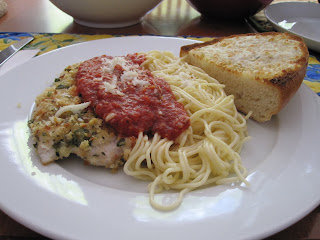
We've had a long week of hard work. We started out on Monday with a basic knife skills lesson from our sponsor and a guest teacher from a local culinary school in the form of preparing a chicken stir-fry. In doing so, we learned the different techniques for cutting various food items from bell peppers to carrots to chicken. Equally importantly, we learned how to properly handle chicken so as to reduce the risk of salmonella poisoning.